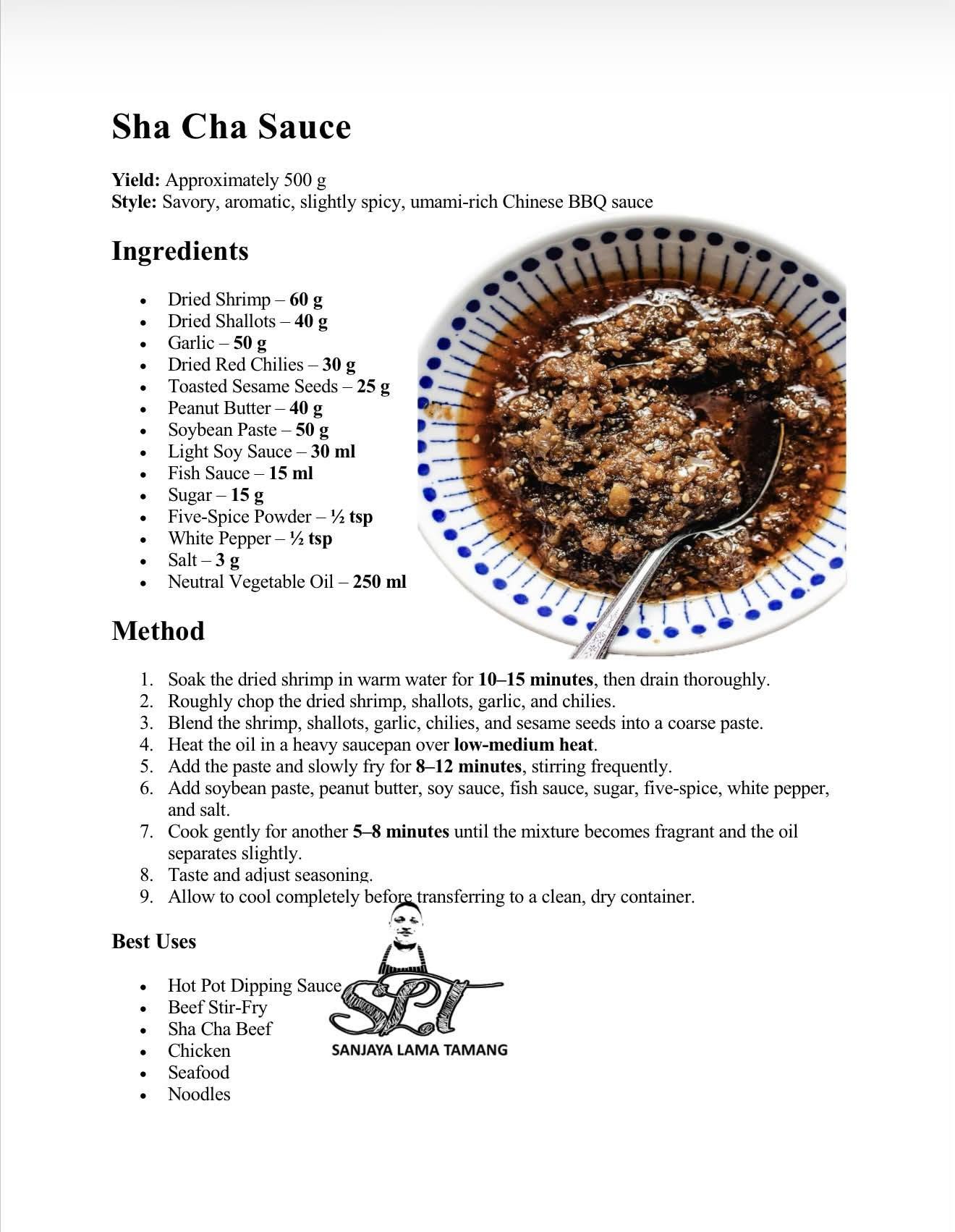
If you have ever eaten hot pot in Taiwan or ordered sha cha beef at a Cantonese restaurant, you have met this sauce. It arrives in a small dish, looks like nothing much — muddy brown, oil slicked across the top — and then completely reorganizes your understanding of what a dipping sauce can do.
Sha cha sauce is savory in a way that is hard to describe to someone who has not tasted it. There is garlic, yes, and chili, and a nutty background from peanuts. But underneath all of that sits a deep, briny, almost smoky note that comes from dried seafood. It is the same category of flavor as anchovy in a Caesar dressing or fish sauce in a Thai curry: you do not taste “fish,” you taste depth.
Making it yourself takes about forty-five minutes, most of which is unattended simmering. The result keeps for weeks and is dramatically better than the jarred version.
What Sha Cha Sauce Actually Is
The name causes endless confusion, so let us clear it up first.
Sha cha (沙茶醬, shā chá jiàng) translates roughly as “sand tea sauce,” which describes nothing about how it tastes. The name is a phonetic accident. The sauce descends from Southeast Asian satay sauce, carried to coastal Fujian and Guangdong by Teochew merchants and returning migrants in the nineteenth and twentieth centuries. “Satay” became “sha cha” in the local dialect, and the sauce transformed along the way.
That transformation is the important part. Sha cha sauce is not peanut sauce. Indonesian and Malaysian satay sauce is peanut-forward, sweet, and often coconut-rich. Sha cha kept the peanuts but demoted them to a supporting role, and put dried seafood in the lead. The result is savory rather than sweet, and it works as a dipping sauce, a stir-fry base, and a noodle seasoning all at once.
The most famous commercial version is Bull Head brand from Taiwan, in the yellow-labeled can. It is genuinely good. But the homemade version lets you control the chili level, the salt, and the grind — and it tastes noticeably fresher.
The Ingredients That Matter
Dried shrimp
Non-negotiable. These provide the briny backbone. Look for them in the refrigerated or shelf-stable section of any Chinese or Southeast Asian grocery, usually in a clear plastic bag. Good dried shrimp are pinkish-orange and smell clean and sea-like. If they smell ammoniated or look gray, find another bag.
Dried flatfish
This is the traditional secret weapon — dried, ground flatfish (sometimes sold as dried plaice, brill, or bianyu). It adds an umami layer that dried shrimp alone cannot reach. It is genuinely hard to find outside a well-stocked Chinese grocery.
If you cannot find it, you have two options. Increase the dried shrimp by half, or add one tablespoon of finely chopped dried scallop or a teaspoon of good fish sauce at the end. The sauce will be slightly less complex but still excellent. Do not skip the seafood entirely — at that point you are making something else.
Roasted peanuts
Unsalted, skinless. They get ground coarsely and contribute body and a gentle sweetness. Roasted, not raw — raw peanuts taste chalky here.
The spice blend
Sha cha’s warm-spice character comes from a small, specific group: five-spice powder, ground coriander, turmeric, and a modest amount of curry powder. That last one surprises people, but it is authentic — a legacy of the sauce’s Southeast Asian route.
Oil
You need more than feels reasonable. The oil is not a cooking medium here, it is an ingredient — it carries the flavor, preserves the sauce, and forms the protective layer on top during storage. Use a neutral oil with a decent smoke point: peanut, canola, or grapeseed.
The Recipe
Makes about 2 cups | Active time 25 minutes | Total time 45 minutes
- ½ cup dried shrimp
- ¼ cup dried flatfish, or an extra ¼ cup dried shrimp
- ½ cup roasted unsalted peanuts
- 8–12 dried red chilies, stems removed
- 1 cup neutral oil
- 1 full head garlic (about 12 cloves), minced
- 4 medium shallots, minced
- 1 tablespoon ground coriander
- 2 teaspoons five-spice powder
- 2 teaspoons mild curry powder
- 1 teaspoon ground turmeric
- 2 tablespoons light soy sauce
- 1 tablespoon brown sugar
- 1½ teaspoons salt, adjusted at the end
1. Soak and drain the seafood. Cover the dried shrimp and flatfish with hot water and let them sit for 20 minutes until pliable. Drain thoroughly and squeeze out excess water — wet seafood will spit violently in hot oil.
2. Grind the dry components. In a food processor, pulse the drained seafood, peanuts, and dried chilies until you reach a coarse, sandy texture. Stop before it becomes a paste. You want visible grit; that texture is characteristic of the sauce.
3. Build the aromatic base. Heat the oil in a wok or heavy saucepan over medium-low. Add the garlic and shallots. This is the step where patience pays: cook them for 12 to 15 minutes, stirring often, until they are evenly golden and the oil smells sweet. If they brown fast, your heat is too high. Burnt garlic will make the entire batch bitter and there is no fixing it.
4. Add the ground mixture. Stir it in and cook for another 8 to 10 minutes over low heat. The sauce will darken and the oil will separate and rise. Keep stirring — the solids sink and scorch if left alone.
5. Season. Add the coriander, five-spice, curry powder, and turmeric. Cook for one minute to bloom the spices, then stir in the soy sauce, brown sugar, and salt. Simmer for five more minutes.
6. Taste and rest. Adjust salt. Let the sauce cool completely in the pan before jarring — it thickens and the flavors settle as it comes down to room temperature.
How to Use It
Hot pot dipping sauce. The classic application. Spoon two tablespoons of sha cha into a small bowl, crack a raw egg yolk into it, and add a splash of soy sauce and chopped scallion. Stir. Dip everything.
Sha cha beef. Sear thinly sliced flank or sirloin over high heat, add sliced onion and a handful of greens, then two tablespoons of sha cha and a splash of Shaoxing wine. Toss for thirty seconds. Serve over rice. This is a fifteen-minute weeknight dinner that tastes like a restaurant.
Noodles. Toss hot noodles with a tablespoon of sha cha, a teaspoon of soy sauce, and a little of the noodle cooking water. Top with a soft egg.
Vegetables. Blanched water spinach or gai lan, dressed with sha cha thinned slightly with hot water.
Marinade. Rub it on chicken thighs or lamb before grilling.
Storage
Transfer to a clean glass jar and make sure the oil layer covers the solids completely. Add a tablespoon more oil if needed — that seal is what keeps the sauce stable.
Refrigerated, it keeps for two to three months. The oil will solidify and the sauce will look unappealing when cold; let it sit at room temperature for ten minutes and it returns to normal. Always use a clean, dry spoon. Introducing water or food particles is what causes a jar to spoil early.
Frequently Asked Questions
Is sha cha sauce the same as satay sauce? No. They share an ancestor, but satay sauce is peanut-dominant and sweet, while sha cha is seafood-dominant and savory. Substituting one for the other will change a dish significantly.
Can I make sha cha sauce vegetarian? You can make something good, but it will not be sha cha. Replace the dried seafood with an equal volume of dried shiitake mushrooms, soaked and ground, and add a tablespoon of fermented soybean paste for depth. Label it accordingly.
Why did my sauce turn bitter? Almost always burnt garlic. It goes from golden to bitter in under a minute. Cook the aromatics over genuinely low heat and pull them the moment they are evenly colored.
How spicy is it? Adjustable. Eight dried chilies produces a mild warmth. Sixteen makes it assertive. Remove the seeds for flavor without much heat.
Can I use a mortar and pestle instead of a food processor? Yes, and the texture is arguably better. It takes about twenty minutes of work.
Internal links to add:
- → beef shawarma marinade (both are spice-forward meat preparations)
- → 3 ingredient asian recipes (sha cha is a shortcut ingredient for exactly this)
- → any hot pot or stir-fry content on the site